
Operators achieve symmetrical side tucks by aligning the gusset blade depth against the center tube profile. Technicians synchronize transport chain lug spacing for the extra film thickness of folded gussets. Correct cross-seal jaw dwell time and air-tuck timing allow the chained bagger to seal four film layers cleanly without tearing.
Mechanical Setup on the Chained Bagger
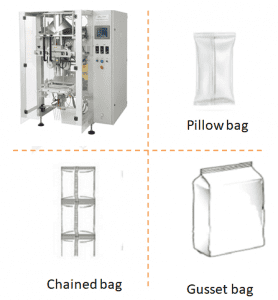
Proper mechanical alignment forms the foundation for consistent gusset formation. Operators must prepare the packaging assembly before introducing pneumatic tucking or heat sealing. The SOONTRUE PILLOW / GUSSETED / CHAINED BAGGER utilizes modular components to facilitate quick physical conversions between standard pillow packs and folded side-gusset bags.
Installing the Gusset Tube on a Chained Bagger
Technicians begin the physical conversion by securing the specialized forming tube. This component features specialized side recessed channels that accommodate mechanical tucking blades.
- Disconnect the primary air supply and engage the main safety stop on the control panel.
- Unbolt the standard pillow bag forming collar from the upper frame mount.
- Slide the gusset forming tube into position, aligning the center outlet with the lower transport path.
- Fasten the mounting bolts loosely to allow precision centering relative to the film feed rollers.
- Verify vertical alignment with a machinist square before tightening all structural fasteners.
Proper vertical alignment prevents material drift across the forming shoulders. A centered tube ensures equal film tension across both left and right web edges.
Setting Mechanical Gusset Blades and Tuck Depth
Mechanical gusset blades crease the moving film web into the side channels of the forming tube. Operators adjust the penetration depth of these blades to control the final volume and side symmetry of the bag.
| Parameter | Standard Target Value | Adjustment Tool | Impact on Bag Quality |
|---|---|---|---|
| Blade Center Clearance | 0.5 mm from tube wall |
Hand knob / Allen wrench | Prevents film tearing and tube friction |
| Tuck Depth Symmetry | Equal left/right depth (±0.5 mm) |
Threaded push-rod | Ensures balanced rectangular bag shape |
| Angle of Engagement | 15 degrees downward pitch |
Locking pivot bracket | Smooths film entry without wrinkling |
Technicians turn the manual adjustment knobs to push the blades inward. The mechanical blades must penetrate deep enough into the tube recesses to form crisp side creases without touching the metal forming tube.
Adjusting Transport Lug Spacing for Gussets
Gusseted bags fold four layers of film along the side margins while maintaining two layers across the front and rear panels. This additional material thickness changes how the transport chain grips and pulls the web down the vertical column.
Technicians adjust the driving chain assembly to accommodate this varying web profile. The drive chain features mechanical lugs that push or hold the packaging material at timed intervals. Operators increase the clearance gap on the side transport lugs to prevent pinch marks on the four-layer film folds.
Operators adjust the chain tensioners to eliminate slack in the drive assembly. Uniform chain tension prevents pitch variation during high-speed continuous transport on the chained bagger. Technicians then rotate the main drive shaft by hand to verify smooth movement through the entire transport cycle.
Film Transport and Sealing Calibration
Once the mechanical setup is complete, precision calibration of air supply and heat parameters ensures high-speed operation. Film transport systems must handle the transition between single-panel film and thick, folded gusset seams smoothly. Fine-tuning pneumatic tucking mechanisms and sealing jaw dynamics prevents product leaks and maintains package appearance.
Calibrating Air-Tuck Timing and Pressure
Mechanical blades initiate the gusset tucks, but pneumatic air jets complete the internal fold right before the cross-seal jaws close. Air-tuck nozzles direct sharp bursts of compressed air into the side channels. This air cushion holds the film inward while the vertical film movement continues down the column.
Technicians configure pneumatic timing via the main touch-screen interface. Set the air burst to trigger roughly 0.05 seconds before the cross-seal jaws make physical contact with the film. Firing the air tuck too early creates unwanted wrinkles along the front panel. Firing the air tuck too late allows the film fold to collapse outward, producing uneven or distorted package edges.
Air pressure levels require careful balance based on film stiffness and line speed:
- Low-Density Polyethylene (LDPE): Set pneumatic regulator to
1.5 - 2.0 barto avoid blowing holes through soft material. - Laminated Barrier Films: Increase pressure to
2.5 - 3.0 barto crisp multi-layer structures effectively. - High-Speed Continuous Cycle: Boost line air pressure by
0.3 barto overcome rapid downward air resistance.
Operators adjust the flow control valves on individual air nozzles to balance left and right tuck volumes. Equal pneumatic force on both sides ensures symmetrical side tucks across every batch.
Aligning Cross-Seal Jaws on a Chained Bagger
Sealing gusseted bags requires precise heat management and jaw alignment. The cross-seal jaws must bind two layers of film along the center panels while simultaneously welding four layers at the side gussets. Standard sealing settings often fail because heat penetration varies across these different layer counts.
Technicians calibrate jaw temperatures, dwell time, and mechanical pressure to bridge this thermal gap. The following table outlines the operational adjustments needed when transitioning from flat pillow bags to folded gusset bags on a chained bagger:
| Sealing Parameter | Two Layers (Flat Bag) | Four Layers (Gusseted Bag) |
|---|---|---|
| Overlapping Layers | 2 layers | 4 layers |
| Required Heating Capacity | Lower heat demand | Significantly higher heat capacity needed |
| Required Seal Pressure | Standard sealing pressure | Higher/more powerful pressure needed |
| Heat Transfer Effect | Heat penetrates fewer layers quickly to melt and bond | Heat transfer must penetrate double the thickness, demanding greater energy to fuse all layers |
Critical Calibration Tip: Thermal expansion alters jaw alignment during extended production runs. Technicians must set mechanical jaw leveling while the sealing bars reside at full operating temperature.
To prevent leaks at the transition point between two-layer and four-layer regions, technicians set spring-loaded pressure springs on the sealing assembly. Higher mechanical force squishes the hot film, forcing molten poly layers into edge gaps. Additionally, operators can enable the nitrogen gas flushing device on the SOONTRUE system during this step. Proper sealing jaw alignment keeps the protective gas charge locked safely inside each sealed pack.
Technicians rotate the drive assembly manually to verify that gusset blades clear the cross-seal jaws on the chained bagger. Operators inspect five sample bags for balanced tucks, clean back-seals, and tight cross seals. Quality assurance requires daily seal checks, mandatory ink testing, and regular peel tests. Finally, operators log mechanical blade positions and pneumatic timing values on machine setup sheets.
FAQ
Why do gusseted bags leak along the cross-seal area?
Uneven film thickness causes cross-seal leaks. Four-layer gusset folds require higher jaw pressure and elevated temperature settings to melt through all material layers completely.
How do operators prevent film tearing during air-tuck timing?
Technicians lower the pneumatic air pressure and set air-tuck timing to trigger 0.05 seconds before the cross-seal jaws make direct contact with the moving film web.
Can the SOONTRUE system switch between pillow and gusseted styles?
Yes. The modular design of the SOONTRUE bagger allows operators to swap forming tubes and adjust mechanical blades quickly for continuous multi-bag style production.
Post time: Aug-05-2026