
A successful investment begins with a thorough internal analysis. Before exploring machine options, a business must clearly define its operational parameters. This foundational step ensures the final selection aligns perfectly with production goals, budget constraints, and long-term growth strategies. A clear understanding of these core needs simplifies the decision-making process and prevents costly purchasing errors.
Calculate Your Target Capacity and Speed
First, quantify your production needs. Calculate the number of bags you need to pack per minute, per hour, or per shift. Consider both your current output and your projected growth over the next three to five years. This target capacity directly influences the required machine speed. A higher speed requirement often points toward more advanced and automated systems, so establishing a precise figure is essential for narrowing down your choices effectively.
Choose Your Rice Bag Type and Material
Next, identify the packaging you will use. Common options for rice include pillow bags, gusseted bags, and stand-up pouches. The material is equally important, with choices ranging from polyethylene (PE) and laminated films to woven polypropylene (PP) for larger quantities.
Tip: The bag type and material directly impact the required sealing technology and material handling components of the rice packing machine. Ensure your chosen machine is compatible with your packaging specifications to avoid operational issues.
Match Automation to Your Labor and Scale
Finally, evaluate your automation needs against your available workforce and production scale. A small-scale operation might thrive with a semi-automatic machine requiring manual assistance. A large-scale producer, however, will benefit from a fully automated system that minimizes labor costs and maximizes throughput. This decision balances the initial capital investment against long-term operational efficiency and labor expenses.
Step 1: Assess Your Core Production Needs
A successful investment begins with a thorough internal analysis. Before exploring machine options, a business must clearly define its operational parameters. This foundational step ensures the final selection aligns perfectly with production goals, budget constraints, and long-term growth strategies. A clear understanding of these core needs simplifies the decision-making process and prevents costly purchasing errors.
Calculate Your Target Capacity and Speed
First, quantify your production needs. Calculate the number of bags you need to pack per minute, per hour, or per shift. Businesses should select equipment that accommodates production rates projected three to five years into the future. This foresight prevents the need for premature upgrades. Higher-speed equipment is more expensive, so budget constraints may influence this decision.
Real-World Example: A coffee company needing to pack 80 bags per minute could only afford a 40-bag-per-minute machine. They purchased it to automate half their line and continued manual packing for the rest. The resulting cost savings allowed them to finance a second machine, achieving full automation with manageable monthly payments.
Choose Your Rice Bag Type and Material
Next, identify the packaging you will use. The material choice impacts durability, branding, and cost.
·PP Woven Bags: These are ideal for large quantities (25-50 kg). Their low cost, durability, and water resistance make them perfect for wholesalers and exporters.
·BOPP Laminated Bags: These bags combine strength with high-quality printing. They are excellent for retail brands aiming for supermarket shelf appeal.
·Plastic (LDPE) Bags: Used for smaller retail packs under 5 kg, this is a flexible, transparent, and cost-effective option for displaying the product.
By 2026, sustainability is a major factor. The market for biodegradable packaging is projected to reach over USD 303 million by 2034, driven by consumer demand and regulations. Choosing eco-friendly materials can enhance brand image and ensure compliance.
Match Automation to Your Labor and Scale
Finally, evaluate your automation needs against your available workforce and production scale. A small-scale operation might thrive with a semi-automatic machine requiring manual assistance. A large-scale producer, however, will benefit from a fully automated rice packing machine that minimizes labor costs and maximizes throughput. This decision balances the initial capital investment against long-term operational efficiency and labor expenses.
Step 2: Explore Types of Rice Packing Machine Systems
Once a business defines its needs, the next step is to explore the available machine technologies. Each system offers distinct advantages in speed, cost, and flexibility. Understanding these core types helps a producer align the equipment's capabilities with their specific operational goals.
VFFS (Vertical Form-Fill-Seal) Machines
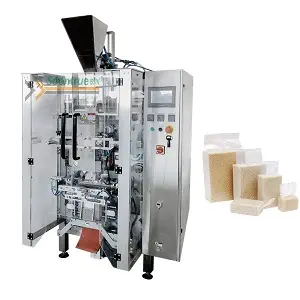
Vertical Form-Fill-Seal (VFFS) machines are a popular choice for their efficiency and versatility. These systems create bags from a single roll of flat film, fill them with rice, and seal them in one continuous vertical motion. This integrated process makes them ideal for high-volume production.
Key benefits of a VFFS rice packing machine include:
·High-speed bag production with minimal film waste.
·Flexibility to create various bag styles like pillow, gusseted, and quad seal.
·Reduced operating costs through continuous automation.
·Compatibility with sustainable materials like paper and PE laminates.
Pre-made Pouch Packing Machines
Unlike VFFS systems, pre-made pouch packing machines work with bags that are already manufactured. An operator loads a stack of these pouches into the machine, which then automatically opens, fills, and seals each one. These machines excel at handling premium packaging like stand-up pouches with zippers, which enhance shelf appeal. While effective, the cost per bag is typically higher, as pre-made pouches are more expensive than the bulk film rolls used by VFFS machines.
Rotary Bagging Systems for High Volume
For large-scale producers, rotary bagging systems represent the pinnacle of packaging automation and speed. These machines use a circular design where multiple stations perform different tasks simultaneously—picking, opening, filling, and sealing bags. This parallel processing allows for exceptionally high throughput, making them ideal for businesses with significant production demands.
Rotary systems are particularly advantageous for high-volume environments where efficiency is critical. Their design facilitates effortless scaling as product demand grows, without compromising quality or speed. While popular across many sectors, they are highly beneficial for commercial food packaging operations. Key industries include:
·Food and Beverage (e.g., pasta, beans, rice, snack foods, frozen items)
·Pet Food and Treats
·Chemical and Pharmaceutical
·Cosmetics
The primary advantage of a rotary rice packing machine is its impressive speed. Different models offer a wide range of capacities, enabling businesses to meet demanding production schedules.
By handling large quantities of products rapidly, these systems empower businesses to meet tight deadlines and large customer orders. Their modular nature also allows for straightforward integration into existing production lines, making them a versatile and powerful investment for growth-oriented companies.
Step 3: Evaluate Key Technical Features
After selecting a system type, a business must evaluate the core components that dictate performance. The weigher, sealer, and material handling mechanisms are the heart of any packaging line. These features directly influence product accuracy, package integrity, and the final quality of the rice, making them critical points of comparison.
Weighing Systems: Multi-head vs. Linear
The weighing system is the key to profitability. It controls product giveaway—the amount of extra product included in each bag. Even a fraction of a gram overfill per bag results in significant losses at high volumes. For rice, the choice often comes down to the required precision and speed.
Sealing Technology: Heat vs. Ultrasonic
A secure seal protects the product and ensures a professional appearance. The two primary technologies for this are heat sealing and ultrasonic sealing.
·Heat Sealing: This is the industry standard. It uses heated jaws to melt and fuse the packaging film. It is a reliable and cost-effective solution for common materials like PE and laminated films.
·Ultrasonic Sealing: This advanced method uses high-frequency vibrations to create a molecular bond. Its main advantage is the ability to seal cleanly through product dust or small particles, reducing rejects and film waste.
Material Handling to Prevent Rice Breakage
Maintaining the integrity of the rice grains is essential for quality. Broken grains detract from the product's value and consumer perception. A superior machine uses gentle handling techniques to minimize impact and friction.
Businesses should look for features designed to protect the product. These include smooth bucket elevators instead of aggressive auger screws and controlled vibratory feeders. Reducing the drop height from the weigher into the bag is another simple yet effective way to prevent breakage.
Tip: Ask suppliers for a product trial. Sending them your rice allows them to demonstrate how their machine handles the grains and helps you verify that breakage rates are within your acceptable limits.
Step 4: Integrate Quality Control and Ancillary Equipment
A packaging line is more than just one machine. Businesses must integrate ancillary equipment to ensure product quality, safety, and regulatory compliance. These add-on systems work with the main packer to create a complete, reliable production line. Investing in quality control tools protects a company's brand reputation and bottom line.
Checkweighers for Weight Accuracy
After the bag is sealed, a checkweigher provides the final verification of its weight. This machine is essential for quality assurance. It identifies and rejects any bags that are underweight or overweight, ensuring every product meets its stated label weight.
Pro Tip: Modern checkweighers can create a feedback loop with the multi-head weigher. If they detect a trend of incorrect weights, they signal the weigher to automatically adjust the fill amount. This smart automation drastically reduces product giveaway and improves overall accuracy.
Metal Detectors for Food Safety
Food safety is non-negotiable. A metal detector is a critical control point for identifying and removing products contaminated with metal fragments. This protects consumers and safeguards the brand from costly recalls. According to FDA guidelines, metal pieces between 0.3 and 1 inch can pose a choking or injury hazard.
Food producers must screen for three main types of metals:
·Ferrous metals like iron and steel.
·Non-ferrous metals such as aluminum and copper.
·Stainless steels, which are the most difficult to detect.
Implementing a reliable metal detection system is a fundamental step in any food safety plan.
Date Coders and Printers
Every package requires essential information for traceability and consumer awareness. Date coders and printers apply batch numbers, expiration dates, and barcodes directly onto the packaging. Two common technologies dominate the industry: Continuous Inkjet (CIJ) and Thermal Transfer Overprinting (TTO).
CIJ systems are a popular choice for their versatility. They use a non-contact method to print high-speed codes on diverse materials, including plastic bags and cartons. These printers can apply everything from simple production dates to complex QR codes and logos, making them a flexible solution for modern packaging needs.
Step 5: Plan Your Budget and Calculate ROI
A comprehensive financial plan is the final step before engaging with suppliers. This involves understanding the full investment cost and projecting its financial return. A clear budget and a positive Return on Investment (ROI) calculation provide the business case needed to move forward confidently.
2026 Price Ranges for Each Machine Type
The initial purchase price varies significantly based on machine type, speed, and features. Businesses can use these 2026 estimates as a starting point for budgeting.
·Semi-Automatic Systems: $15,000 – $40,000
·VFFS Machines: $50,000 – $150,000
·High-Volume Rotary Systems: $150,000 – $400,000+
These figures represent the base cost. The final price will depend on customizations, ancillary equipment, and manufacturer choice.
Factoring in Installation, Training, and Maintenance
The sticker price is only part of the total cost of ownership. Businesses must also budget for several other essential expenses. These include one-time costs for shipping, installation, and operator training. More importantly, they include recurring maintenance costs.
For automated machines, the annual cost for replacing wear parts typically ranges from 1% to 3% of the initial purchase price. A machine costing $50,000, for example, would incur annual maintenance expenses of $500 to $1,500 for items like belts and heaters.
How to Calculate Your Return on Investment
Return on Investment (ROI) measures the profitability of the equipment purchase. It justifies the capital expenditure by showing how quickly the investment will pay for itself through efficiency gains and cost savings. A simple formula helps calculate this critical metric.
ROI = (Net Benefit / Total Equipment Cost) x 100
The net benefit includes labor savings, increased production output, and reduced product giveaway. For instance, if a packaging system costs $200,000 and generates a net annual benefit of $150,000, the ROI is 75%. This powerful figure demonstrates the financial viability of the investment to stakeholders.
Selecting the right rice packing machine is a critical investment in operational efficiency. A business must first prioritize its core needs, including capacity, bag style, and automation level. A thorough evaluation of technical features alongside long-term costs ensures a profitable purchase. This guide provides a clear checklist, empowering companies to confidently engage with suppliers and secure the best equipment for their growth.
FAQ
Can one machine pack different bag sizes?
Yes, many modern machines offer this flexibility. A business can easily adjust settings or swap out forming parts to accommodate various bag widths and lengths. This feature allows a company to adapt to changing market needs with a single investment.
What is the typical lifespan of a rice packing machine?
A well-maintained rice packing machine generally operates for 10 to 15 years. Its longevity depends on build quality and consistent maintenance. Regular servicing and timely replacement of wear parts are essential for maximizing the equipment's operational life.
Can these machines pack products other than rice?
Yes, these systems are highly versatile. They efficiently package a wide range of granular and solid products.
Common applications include beans, grains, sugar, salt, nuts, pasta, snack foods, and pet food. This adaptability makes them a valuable asset for businesses with diverse product lines.
How do I choose a reliable supplier?
A business should select suppliers with a strong industry reputation and positive customer reviews. It is wise to request case studies and verify their after-sales support. A reliable partner provides installation, training, and prompt access to spare parts.
Post time: Nov-12-2025